
Flamenco guitar vs classical guitar: A beginner's guide
If you’re thinking of picking up flamenco guitar, chances are you already play another genre of music like classical. So what you really want to know is… How’s flamenco guitar different? Is flamenco harder to play?
Can you even play flamenco on a classical guitar?
Let’s find out…
Is the flamenco guitar really that different?
Flamenco guitars and classical guitars look very similar. They’re both acoustic (non-electric) guitars with nylon strings (six of them in fact!). So is there really any difference from one instrument to another?
Well… yes. But it’s not as big a deal as you might think.
A flamenco guitar is not constructed in a completely different way to a classical guitar. The biggest differences between them are in the way the guitar is set up. A guitar designed specifically for playing flamenco has a few features that make it more suitable for the flamenco style.
The Golpeador
You’ve probably already noticed that flamenco is far more percussive than classical music. A key technique in flamenco is a rhythmic tap on the guitar, known as a golpe.
Flamenco guitars have a thin plastic plate above and below the sound hole, known as a golpeador or tap plate. This allows the guitarist to tap the guitar without damaging the wood.
Most golpeadores are made of clear plastic so you don’t even notice them unless you’re looking.
Lower string action
Lower string action (the distance between the strings and the fret board behind them) gives flamenco guitar more buzz in its sound than would be acceptable in classical music.
In practical terms this means that the strings are lower or closer to the fretboard making a flamenco guitar faster to play and giving a punchier sound.
It’s not all black and white…
Now I said that the main differences between flamenco and classical guitars are in the way they’re set up. But… the wood they’re constructed with can also make a difference. We have history to thank for this…
Traditionally flamenco guitars were made from lighter wood. Historically this was a spruce top and cypress back and sides, simply because these woods were locally available in Spain and made cheaper guitars.
Flamenco guitars were (in the beginning) just the cheaper guitars on the market! Don’t forget that flamenco emerged in the 19th century in the lower social classes of Andalusia. There was no money for a top of the range guitar in these communities.
Luthiers today still make flamenco guitars from cypress but unfortunately they’re no longer the cheapest guitars. The wood does give a more percussive and lively sound which is desirable in flamenco.
Because cypress is a lighter coloured wood, these guitars are sometimes knowns as Blancas (white) as distinguished from Negras (black) that are made from darker wood. Rosewood, for example, offers more sustain, which is what you want in a classical guitar. So what began as an economic matter is now a characteristic part of the flamenco aesthetic.
Many flamenco guitarists still opt for Blancas but you don’t need one to play flamenco. In fact legendary flamenco guitarist Paco de Lucia popularised playing on a Negra guitar. Whether you prefer the sound of cypress or rosewood is a question of taste.
Can you use a classical guitar to play flamenco?
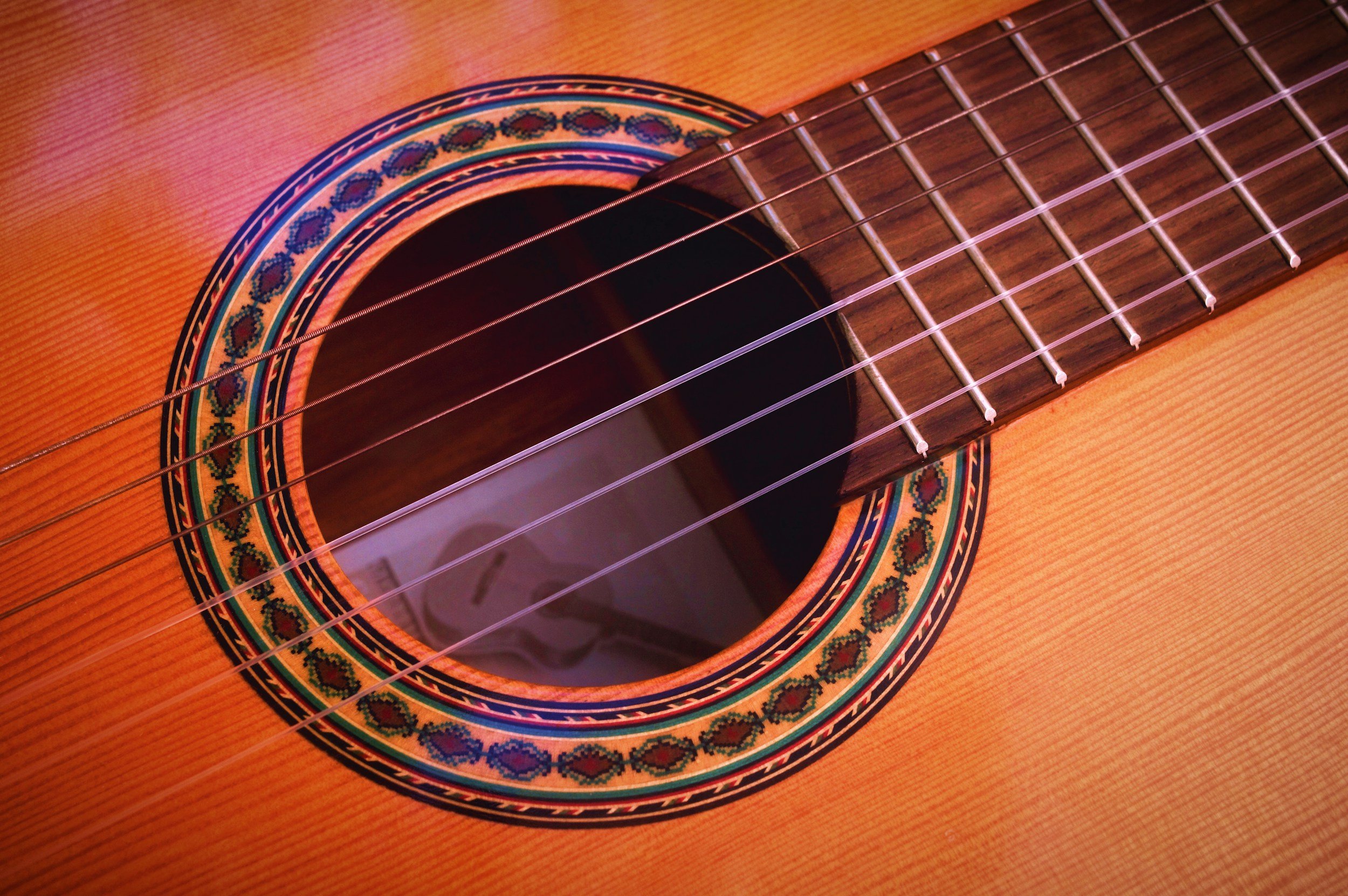
Yes! Absolutely.
Especially if you’re just starting out then a classical guitar is fine. Just make sure you have nylon strings. (Apart from the influence this has on the sound, steel strings will shred your nails and fingers.)
A guitar that has been very specifically set up for classical music is going to be harder to play flamenco on (and vice versa) but really any nylon string acoustic guitar is going to be versatile enough for beginners in both genres. You can always add a golpeador to your classical guitar.
So if you’re at the beginning of your flamenco journey, it’s absolutely fine to start out on whatever you’ve got. Go for it!
If you are ready to buy a flamenco guitar, what should you get? The answer depends on a lot of variables: What sort of sound do you prefer? What can you afford? And what’s actually available in your price range? If you don’t know where to start I highly recommend this article from Flamenco Explained.
What’s so special about flamenco guitar technique?
I once heard a radio announcer ask what’s the difference between a cupcake and a muffin. Stay with me here…
One caller said: “Cupcakes are made with cake mixture and muffins are made with muffin mixture.”
Well, the same kind of reductive statement can be said for guitars. What makes a flamenco guitar different to a classical one? Flamenco guitars are made for playing flamenco and classical guitars are made for playing classical. Got it?!
The point I’m trying to make is that, despite listing the differences between them above, a flamenco guitar is really better defined by the way its played rather than by its physical characteristics.
Yup the golpeador and the lower string action set a flamenco guitar apart from a classical one, but they are there because of what the guitarist does with them.
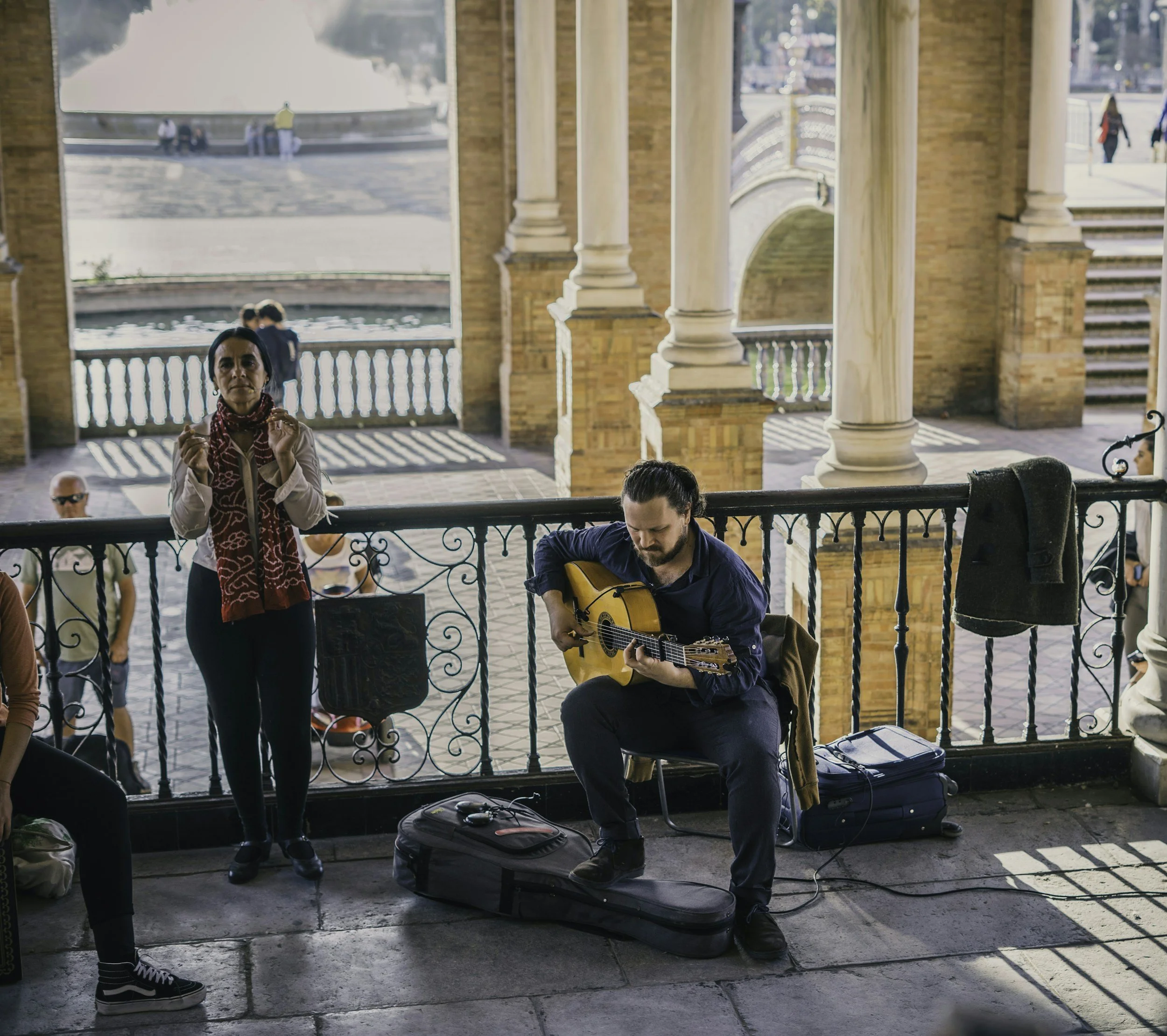
The work of the flamenco guitarist is to accompany dancers and singers. It requires a far more assertive sound and the guitarist’s job is to provide percussion and rhythm just as much as melody.
(Of course solo flamenco guitar has become an art in its own right, but let’s leave that aside for now.)
Techniques that define flamenco include rasgueado (strumming), alzapúa (combining a thumb technique with strumming) and pulgar (a thumb technique). They give the distinctive rhythmic and percussive flamenco sound.
Flamenco of course incorporates other techniques as well. You might have heard of arpeggio, tremolo and picados. Historically these are classical techniques that were incorporated into flamenco in the 20th century but today they are very much part of the flamenco style. Think of Paco de Lucia without picado… Impossible!
If you want to know more about these techniques just search for them on YouTube, where you can find so many great channels about flamenco these days. I’m not just talking to aspiring guitarists here… Dancers it’s also worth us learning what these techniques are so we can communicate more easily with guitarists!
The all important compás
What really sets flamenco guitar apart from other genres is the compás or the rhythm of the different flamenco styles. Flamenco uses 3-beat, 4-beat and 12-beat rhythmic cycles depending on the palo (style).
Compás is fundamental to flamenco because it’s what unifies the guitarist, the singer and the dancer. It dictates when the singer brings in the melody, how the dancer structures their steps and the beats that the different performers accent.
The guitarist has a critical job of keeping ‘in compás’. That includes keeping ‘in time’, adjusting the speed according to the other performers, accenting certain beats and using the techniques I mentioned above to reinforce the compás.
Because compás underpins so much of flamenco guitar, understanding it first makes your life so much easier when it comes to picking up your instrument.
My best tip (for everyone, not just guitarists!) is to listen to as much flamenco as you can to help you internalise the compás.
Ready to start?
Flamenco can feel a little intimidating when you’re new but the good news is you don’t need to go out and buy a special guitar or take a trip to Spain.
The best way to learn flamenco guitar is to stop reading about it and start playing!
Visit our directory of teachers and classes to find the right fit for you: Flamenco Australia Magazine Classes Directory
FAQs
Is flamenco guitar harder than classical guitar?
Flamenco guitar isn’t necessarily harder to play, but it is very different from classical guitar. There’s a much greater emphasis on percussive and rhythmic techniques such as rasgueados.
Playing with singers and dancers also requires a different skill set. Flamenco is much more rooted in improvisation and learning by ear, so there’s no requirement to read sheet music.
If you’re unsure of which path to take, listen to the music and ask yourself which genre inspires you more.
Is a flamenco guitar the same as a ‘Spanish guitar’?
Not exactly. The term ‘Spanish guitar’ is somewhat ambiguous. Flamenco guitars are Spanish guitars, but the term can also be used to refer to classical Spanish guitars.
Where can I learn flamenco guitar in Australia?
Explore our directory of teachers and classes to find a teacher near you.