Why cante is the key to understanding flamenco
In this article we look at the oral tradition behind flamenco and why it shapes how we experience flamenco today.
Don’t ignore the cante!
Here’s a confession: I’d been studying flamenco dance for years before I began to understand the importance of the cante (singing).
In the early days my ears were actually shocked at hearing flamenco music. The cante felt inaccessible to me and I was too fixated on trying to follow the compás (rhythm) to care about much else.
Later when I travelled to Spain and had the opportunity to hear live flamenco, something clicked.
I took classes in Seville and was amazed to find a singer often in the studio. I began to realise that my teachers were choreographing WITH the music and adapting the steps to different letras (verses).
In Australia we are lucky to have SO MANY great flamenco artists. And yet having a singer in the classroom is a rare luxury. So you can understand, with such little exposure, why I didn’t realise the importance of the cante.
When I went to tablaos and other flamenco venues in Spain I saw that flamenco is a dynamic relationship between the performers. The dancer and guitarist need to work together with the singer and follow the cante.
It’s what my teachers had been telling me, but I hadn’t understood why.
Don’t make the same mistake as me! My goal here is to convince you that the cante isn’t just ‘important’, it’s a critical part of flamenco that you can’t afford to ignore!
Whether you’re a dancer, a guitarist or an enthusiastic spectator, recognising the role of cante in flamenco will help you so much in your understanding of this art form.
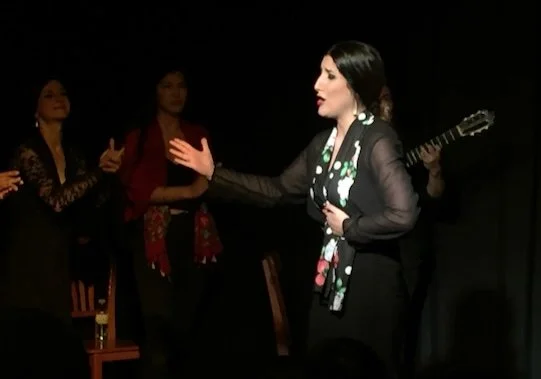
Why cante is integral to flamenco
To understand the role of cante in flamenco we need to look at where it’s come from.
We often hear that flamenco is “Andalusian” or “Gitano” (Spanish Romani) but the real story is much more complex.
Without diving too deep into history it’s important to know that Southern Spain has been conquered several times… by the Phoenicians, the Romans, the Moors… You get the idea.
All of these invasions and migrations left their mark. By the15th century southern Spain was a picture of ethnic and religious diversity including Jewish, Muslim, Christian and Gitano peoples.
You can imagine the richness of all these cultures mixing with primitive Andalusian folklore.
But then the 16th century came along and changed everything.
Isabella I of the kingdom of Castile and Ferdinand II of Aragon married. By linking their kingdoms they created a unified Christian Spain. And they expelled Jewish, Muslim and Gitano peoples in the process.
These persecuted cultures and their folklore were forced underground. And it was out of this diverse cultural mix that flamenco surfaced in 19th century Andalusia.
Why does any of this matter?
Flamenco emerged in Gitano communities on the back of Andalusia’s diverse and often marginalised folklore— folklore that was passed on orally, not learnt in institutions.
The voice, the cante, was the primary way of preserving, celebrating and sharing the unique culture that had developed in the south of Spain.
Flamenco dance and flamenco guitar didn’t come out of nowhere! They were born within this complex union. They are dependent on and related to the cante.
Without the cante, flamenco simply wouldn’t exist.
How cante informs the different styles of flamenco — the palos
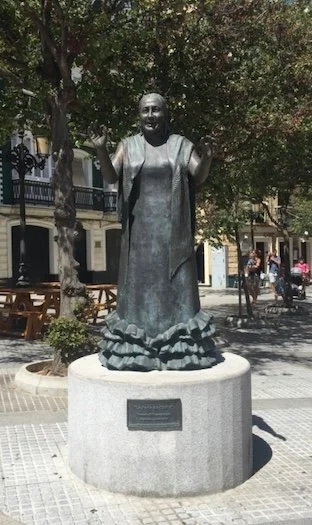
Celebrated flamenco singer La Perla — statue in Cádiz
At the time flamenco was coming into being in the late 18th and early 19th centuries, there were no recordings. Flamenco was learnt by ear.
Yes, we’re still on the history. Just a little bit more, I promise.
Flamenco developed in the lower social classes of Andalusia. It was sung in homes and communities. It was informal.
So as the cante was shared and passed on from singer to singer, it had the opportunity to evolve.
With each new interpreter came variations and changes to the cante as the singer adapted the music to their own personal style and abilities and according to what they remembered (or didn’t!).
The lyrics are not important here (we’ll get to that later). We’re talking about the melodies that were interpreted and reinterpreted, defining elements of the cante.
This process of repetition with variations gradually produced recognisable patterns in the melodies, rhythm, and expression, forming the basis for different styles.
The cante ultimately created the different flamenco palos (styles) we know today.
Palos are not fixed compositions. Think of a palo as a form or a framework containing fragments of cante.
This is very different to the way we think of music in the west where we are familiar with a song being a fixed expression.
If you don’t know Tayor Swift’s “Shake it off” there’s really nothing stopping you from learning it from beginning to end.
But flamenco isn’t packaged this way! We need to learn the guidelines or norms of a palo rather than approach it as fixed.
How?
If you want to get to know a palo, get to know the cante!
The main palos we typically see today include Alegrías, Soleá, Seguiriyas, Tarantos, Tientos, Bulerías, and Tangos but this is just a subset of the breadth of flamenco.
To get an idea of just how big flamenco is, take a look at the the map of palos on Flamencopolis.
The lines on the map go everywhere because flamenco isn’t a linear creation but rather the result of musical contamination, with artists sharing their art and building on one another.
In this sense, flamenco is incredibly organic, flexible and full of variations.
“Just how flexible?”, I hear you ask!
Let’s take a look at how and why the cante can vary so much.
Cante is not fixed #1 — melodic variations
Within each palo we have a range of different melodies.
Again, this is a result of the oral transmission of flamenco.
Do I sound like a broken record? (No irony intended!)
We’re all familiar with how a message can be distorted as it’s passed from one person to another. The same is true for melodies.
There are a number of reasons why a melody can change and this is where flamenco history can be hard to pin down.
A singer might alter the notes simply to better suit their voice or preferences.
Different lyrics sometimes produced new melodies - not because the lyrics themselves are linked to a specific melody, but because by changing the words the original melody had to adapt to accomodate the modification.
Try it for yourself. Take the first lines of “Twinkle twinkle little star” and “Baa baa black sheep” — they’re essentially the same melody BUT notice the extra notes in the second version to match the extra syllables in “have you any wool”. It simply sounds better that way.
Hey, sometimes a new melody was created because the singer made a mistake and liked it! Or forgot the original version!. Or wanted to mix together influences from two different singers — a 19th century flamenco remix!
If I sound blasé it’s just because there isn’t a lot of evidence to show how and where these iterations happened.
The absence of any tracking or recording makes it difficult to trace these evolutions, and that’s precisely why they occurred!
The result is that within each palo there are a range of melodic interpretations. We can call them variations or styles. (But don’t confuse this with flamenco styles, as in ‘palos’!)
When a singer performs, say Alegrías, they will sing multiple letras each with a different melody.
In Western music a song usually consists of multiple verses with the same melody!
But in flamenco the singer has the freedom to choose from their repertoire and perform a variety of melodic interpretations from the palo.
Knowing this helps to explain why flamenco dance and guitar are not formulaic. How can they be if each sung letra is different?
Cante is not fixed #2 — interchangeable lyrics
As we’ve already seen above, the melody is the defining feature of a palo, not the lyrics. In fact the melody and lyrics in flamenco are entirely separate.
If I say “Billie Jean is not my lover”, you will probably start humming the tune to this Michael Jackson song.
But a melody in flamenco, a letra of Soleá for example, can be sung with a range of different lyrics. In fact some lyrics are even shared across palos!
The singer chooses different lyrics according to what they’ve learnt or their personal preferences.
This level of freedom might appear overwhelming at first but in some ways it makes things simpler for the guitarist and dancer. The lyrics simply don’t matter. You don’t need to know the words to know where you are in the letra: it’s the melody that counts.
Cante is not fixed #3 — the performance is personal
We’ve seen that within a palo the singer can choose the melody they perform and the lyrics to go with it. But flamenco is more than a mix and match art form.
The singer has the freedom to add a huge amount of personalisation to the cante within the boundaries of the palo. It’s a veritable choose-your-own-adventure!
How’s that?
Within a letra a singer might play with the words, stretch or shorten lines, repeat them, link lines together or leave a break between lines.
This doesn’t mean the singer has the freedom to sing a letra backwards or in complete gibberish! There are rules and norms about how the cante is executed according to the palo.
But the singer has a huge amount of freedom to interpret the cante in different ways.
Confusing? Yes! But that’s the beauty of flamenco!
Listening to the cante
If I haven’t convinced you by now, let me say it: Flamenco is experiential!
Flamenco is a complex art form born out of many folkloric influences. It has evolved through oral transmission and is highly flexible, with the singer having the freedom to choose from different melodies, lyrics and personal preference in how they execute the cante.
The variability of the cante gives so many creative possibilities!
But if you’re trying to find your way in flamenco, that degree of flexibility can be overwhelming.
An aspiring guitarist can learn how to play “Stairway to heaven” without needing anyone to sing it. A tap dance student can learn the steps to a choreography without thinking about the melody it’s set to.
Nothing against Led Zeppelin or tap dancing but this approach doesn’t work in flamenco.
I started learning flamenco with that same mindset, but it only gets you so far.
If you want to go deeper on your flamenco journey, you need to understand the basics of the cante.
Does that mean you need to learn to sing as well? No!
(Although it will definitely help you!)
Simply listen to the cante. At least a little!
The more you listen, the more you will hear the different melodies. It then becomes easier to understand the parameters of a palo and discern where a letra starts and finishes, what to do if there are pauses, and where the guitarist and dancer need to respond.
You don’t need to learn Spanish for this, but it is helpful to build a vocabulary of key terms.
You might already know, for example, that Alegrías always begins with the classic “tirititrán”. This is known as the salida or introduction to the cante, and although it’s specific to Alegrías, other palos have their own salidas.
Identifying the components of the cante like this gives us a framework for understanding and communicating about how the flamenco singer, dancer and guitarist work together.
Learning flamenco today
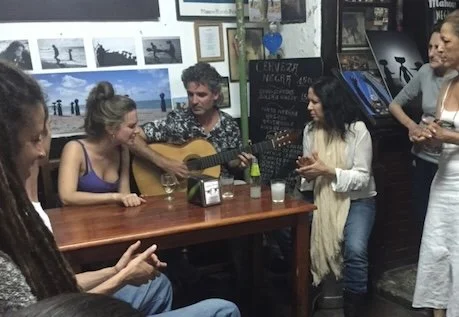
The degree of flexibility in the cante means that what we see in a performance or learn in class is just a snapshot of the possibilities within flamenco.
Once we see cante, guitar and dance as a creative trinity we open ourselves to the possibilities of flamenco.
Today we have the benefit of recordings and videos to do this. Watching and listening to different ways of executing flamenco can teach us a lot.
But as flamenco evolved through oral transmission, it helps enormously to learn flamenco this way too. Live performance is wonderful for learning the mechanics of flamenco! Especially if you have the opportunity to travel to Spain and see improvised flamenco in tablaos, peñas or social settings. These places are like living archives for flamenco.
If you have the opportunity to go to Spain then do it!
There’s nothing better than learning from the lived experience of flamenco.