
The Festival de Jerez: How to get the most out of this annual flamenco festival
The Festival de Jerez is a highlight on the flamenco calendar, especially for dancers. Plus Jerez has so much to offer besides the festival! Here’s everything you need to know to plan your trip.
This article includes affiliate links. If you click and purchase through them, I may earn a much appreciated commission at no extra cost to you.
What is the Festival de Jerez?
This annual flamenco festival is one of my absolute favourites! I’ve had a special place in my heart for it since I first attended back in 2014. It was my first festival experience and I was gripped with flamenco fever!
What makes the Festival de Jerez unique is that it combines courses and performances. The concept is genius: two full weeks of classes with nightly shows.
And here’s the best part…
If you enrol in one of the festival’s weekly workshops your registration includes tickets to six evening shows during that week!
In 2027 the 31st edition of the Festival de Jerez runs from 19 February to 6 March.
It’s a cliché, but the city of Jerez really comes alive during the festival with a constant buzz of activity in its streets, bars and flamenco venues. The main performances take place at Jerez’s historic Teatro Villamarta (Villamarta Theatre) but other shows and workshops happen across the city. If you’re looking for an immersive flamenco experience then this festival makes a lot of sense!
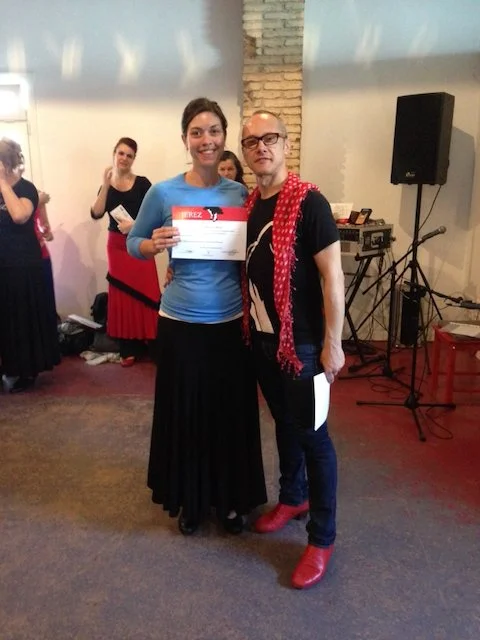
Me, Cathy, with my teacher Manuel Betanzos at the 2014 Festival de Jerez.
Who the festival is for
The Festival de Jerez really appeals to flamenco dance students who want to take advantage of the range of courses on offer with some of Spain’s best flamenco artists.
Not a dancer? You’re still welcome! But there are only a few classes available that are not dance specific.
Locals who have year-round access to flamenco won’t find the registration fee competitive. But if you’re a dance student coming from outside of Spain with just one or two weeks to spend, then this festival condenses a lot of value into a weekly format. When I first attended in 2014 I was living in Australia so it made sense to go all in for the week-long workshops. Later when I lived in Seville it was easier to visit Jerez for select performances.
Of course, classes are just one part of the festival. Anyone can attend the shows, so even if you’re not a flamenco dancer there’s still plenty to enjoy.
What’s on offer at the 2027 Festival de Jerez
The program for the Festival de Jerez is released in two stages: Courses are open for enrolment from September 2026 while the program of shows isn’t released until much closer to the festival.
At the time of writing the program of shows is yet to be released. This article will be updated once the full program is available, so check back soon!
Festival courses and workshops
The 2027 Festival de Jerez offers three types of workshops: 7-day courses, intensive courses and workshops. These are held at studios across Jerez, which is fortunately a small and easily walkable city.
Courses fill up quickly (there are only 25 spots in each class) so book early.
You can view the full program of courses on the Festival de Jerez website.
7-day courses
The 7-day dance courses are the festival’s main offering. When you enrol in one of these, the registration fee includes tickets to six shows at the Teatro Villamarta for the same week.
There’s a wonderful range on offer this year covering numerous palos (styles) with some incredible teachers such as Mercedes Ruiz, Manuel Liñan, Beatriz Morales and more. Each course also has a guitarist and singer present to support the teaching, which is a great help if you want to better understand the palo.
Courses are available at all levels from beginner to advanced and the prices vary accordingly, from 350 euros at ‘initiation’ level to 390 euros at ‘proficiency’ level. Discounts are offered if you register for more than one class in the same week. Keep in mind that the levels in Spain are usually higher than those abroad, so an advanced class in Australia might be closer to an intermediate level in Spain.
The courses are offered at three time slots:
Mañana from 9:30am
Mediodía from 12:30pm
Tarde from 3:30pm
The beginner classes run for 1.5 hours each day and the other classes fun for 2 hours. Technically this means you could fit in three courses a day, but speaking from experience, one or two is best! In 2014 I squeezed in official courses with Manuel Betanzos and Leanor Leal, plus an off-festival course with La Moneta… I could barely walk to the Teatro Villamarta for the evening show! So make sure you leave yourself time to eat, stretch, shower and rest!
Intensive courses
In 2027 the Festival de Jerez is offering six full day intensive courses on Saturday 27 February from 11am to 1:30pm and again from 3pm to 5:30pm. All the intensive courses are open level.
If you can’t stay for a full week of the festival, this is a great option for the weekend.
The registration fee for the intensive course is 150 euros and this includes a ticket to the show taking place in the Teatro Villamarta that evening.
Workshops
Not a dancer? The Festival de Jerez also offers a small handful of Monday-Friday workshops covering other aspects of flamenco.
In 2027 topics include Compás y palmas flamencas (Flamenco rhythms and hand clapping) and Comprendiendo el cante flamenco (Understanding flamenco singing). For guitarists there is one workshop on offer with Jerez guitarist José Ignacio Franco.
Workshops cost 150 euros and don’t include tickets to shows.
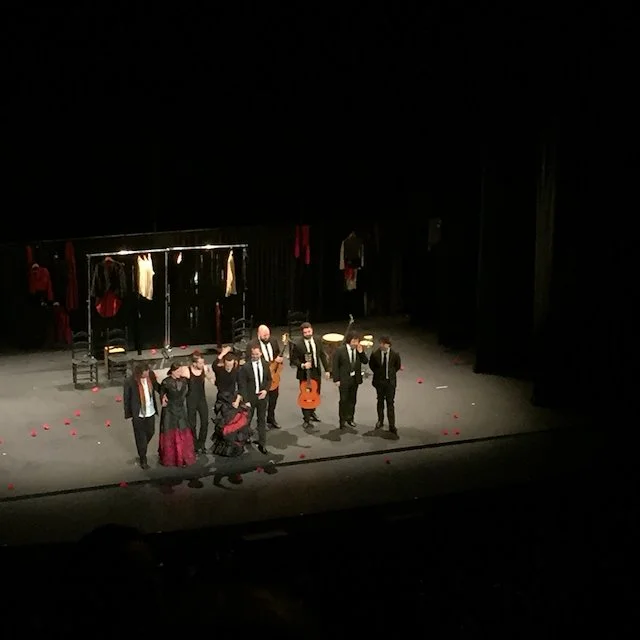
Festival shows and other activities
The Festival de Jerez has a reputation for a program packed with top flamenco artists and world premieres.
The variety of performances is tremendous. There’s at least two shows on every day and a much bigger program on the weekends, from full-scale productions staged in the Villamarta Theatre to more intimate performances in smaller venues. The program definitely includes contemporary flamenco but it’s generally considered less avant-garde than Seville’s Bienal festival.
Almost every evening there is one ‘main show’ at 8:30pm in the Teatro Villamarta. If you’ve booked into one of the festival’s weekly courses, you will receive tickets for six of these shows in your registration. When I attended back in 2014 the allocated seats for these tickets were in the balcony section of the theatre. It’s an amazing view, but worth bearing in mind that if you have a friend who’s purchased a ticket to the show separately, you may not be able to sit together.
In addition to the main attraction, afternoon and evening shows are staged in venues across Jerez. The shows are staged at different times, so it’s absolutely possible to do more than one show a night.
In 2016 when I lived in Seville I caught the train down to Jerez with my friend for a full night of flamenco. Starting at the Teatro Villamarta to see Manuel Liñan, we then caught the late show at La Guardia del Ángel before going to see Saray García perform at 1am (although I’m sure it started significantly later). We only had about an hour to spare before catching the first train of the morning back to Seville. I don’t recommend it, but it is possible!
The festival also collaborates with the local association of flamenco clubs to offer a program of local youth artists in various peñas (clubs) around Jerez. This is a great lens onto the world of flamenco. The peñas usually draw a crowd of locals and the talent is phenomenal.
Tip: The peña shows aren’t ticketed, so arrive early to make sure you secure a place before the doors close.
Haven’t seen enough flamenco? The Festival de Jerez also offers a range of parallel activities to keep you entertained between workshops and shows. The program typically includes screenings of documentaries, exhibitions, open rehearsals and a flashmob.
At the time of writing the program of shows is yet to be released. This article will be updated once the full program is available, so check back soon!
Do I need to speak Spanish to attend the Festival de Jerez?
Speaking Spanish will make your experience at the Festival de Jerez easier, but it’s not essential.
The festival website is only available in Spanish and all courses during the festival are taught in Spanish. Learning a few key words before your visit will help you better understand what’s happening in the courses. English isn’t widely spoken in Jerez so knowing a few basic phrases will also help you when you’re out and about in the market or ordering a coffee.
That said, the festival draws a large international crowd. In my experience there’s always someone nearby to help translate if you’re having trouble communicating. When I visited Jerez for the first time I knew very little Spanish so I appreciated the help of my friends and other festival attendees, but I also managed to get by when I was on my own.
How to register and book your festival tickets
Booking tickets in the Festival de Jerez is a two step process. Course registrations open first, whereas tickets to shows go on sale when the program is released a few months ahead of the festival, typically in December.
Course registration for the 2027 Festival de Jerez open from 14 September 2026. You can enrol and pay with credit card through the festival website. Courses do book out quickly, so don’t wait until the program of shows is released to register for courses.
Tickets to shows need to be bought individually (except in the case of the six shows included in your ticket if you enrol in one of the 7-day courses). You can buy your tickets online or at the Teatro Villamarta box office once the program is released.
At the time of writing, tickets for 2027 shows are not yet available. Going on 2026 as a guide, prices ranged from 20 to 40 euros. The festival offers some discounts including discounts on tickets for shows on the same day, and discounts when buying tickets to see multiple performances at the one venue (conditions apply). As a bonus, the festival’s youth performances in peñas are all free!
Understanding the festival geography
Events in the Festival de Jerez take place in performance venues and studios around the city centre. The heart of the activity is Jerez’s Teatro Villamarta on Plaza Romero Martinez, which hosts the festival’s main shows and is also where you’ll find the ticket booth.
Unfortunately, the festival does not release the location of its workshops prior to registration. The good news is that Jerez is relatively small and walkable so it’s quite easy to get from one venue to the other, and there’s always flamenco happening somewhere! Think of Jerez city centre as one giant stage during the festival!
How to get to Jerez
Jerez de la Frontera is just south of Seville. It takes roughly an hour to get to Jerez from Seville by train.
Jerez also has its own airport, but there are fewer direct international flights in winter. If you’re looking at flying then your itinerary will probably include a stopover in Madrid or Barcelona. I suggest comparing flights to Seville, as it’s so close to Jerez and very easy to get between the two cities by train.
Car hire is also an option, but probably less practical for a lot of visitors as you’re unlikely to use the car during the duration of the festival. I have travelled to Jerez by car with friends and using the BlaBlaCar app, and it can be convenient if you are only planning on driving in one evening to see a specific show, or if you want to add a road trip to your visit.
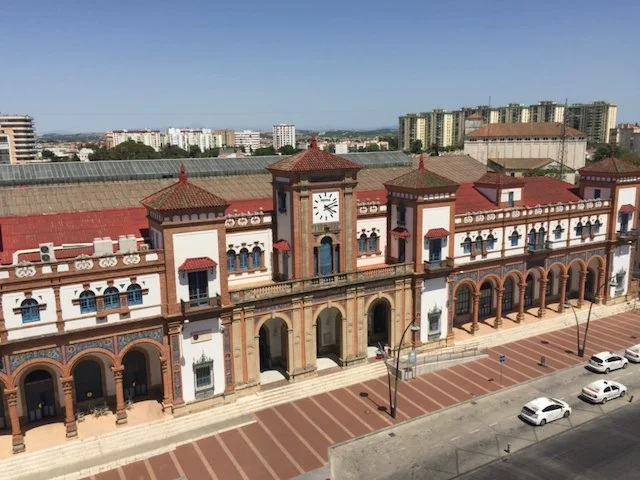
Jerez’s beautiful train station
Where to stay: Planning your accommodation in Jerez
Jerez is relatively small and this festival draws a large international crowd, so you definitely want to make sure you have your accommodation lined up nice and early.
The difficulty is that the festival does not release the location of its courses prior to registration, and its program of shows isn’t published until close to the festival date, usually around three months prior. This means you’re in a position of booking your accommodation before you know where your courses are being run and which venues you’ll be visiting for shows.
Fear not! Almost anywhere you book to stay in Jerez city centre is manageable as its quite small and walkable. My best advice is to book close to the Teatro Villamarta which is the heart and physical hub of the festival.
Consider whether or not you need a kitchen or if you’re planning on eating out. Don’t worry about booking somewhere with a pool; it’ll be far too cold to swim. In fact you might want to look for a place with heating as Jerez can get very cold on winter nights.
Check out the map below for accommodation options around the Villamarta Theatre.
Affiliate disclosure: I may earn a commission if you book through this map, at no extra cost to you. Listings aren't necessarily my recommendations, so please check independent reviews before booking.
Beyond the festival: What else to enjoy in and around Jerez
Like any major festival, some of the most interesting experiences happen in the ‘off-festival’.
There are numerous workshops on offer beyond the official festival program. Check out local studios who offer special programs and courses during the festival.
For example in 2027:
The Centro de Baile Jerez is running weekly and weekend courses.
Chiqui de Jeré has a huge program of courses on offer throughout the festival period.
Patricia Ibáñez is also offering an amazing program at her Centro de Baile Flamenco.
And there are others! Often smaller studios announce their courses closer to the date so keep an eye on social media to find the latest offerings.
I really can’t overstate the fact that Jerez lives and breathes flamenco in every corner during the festival. Local flamenco venues have full programs of events that get packed out. These are often performances that you can’t buy tickets to ahead of time, you just have to line up and hope you make it in before doors close.
Venues to keep an eye on are La Guardia del Ángel, Peña Flamenca Buena Gente and other flamenco clubs, tabancos and bars across the city including the famous and much loved (by me!) Tabanco El Pasaje.
With all that flamenco you might not find a lot of time for other cultural experiences in Jerez beyond a quick glass of sherry before a show. But if you do find yourself at a loose end (or if you’re travelling with someone who isn’t spending the day dancing) you might like to visit the Jerez Cathedral, Alcázar or one of the bodegas (wineries) that helped Jerez to make its name. My number one recommendation is a visit to the local Andalusian Hammam. This small but tasteful Arabic bathhouse is pure bliss for tired muscles. No affiliate link here! I just adore this place.
Final thoughts: Why the Festival de Jerez is my favourite flamenco festival
I know I’m biased as I absolutely love the location. But as a flamenco dancer you just can’t get better than the Festival de Jerez in terms of calibre and scale of events.
The courses are considered expensive but when you factor in the inclusion of six tickets to world-class flamenco shows I think it’s a very reasonable offer. If you’re not interested in the festival’s courses you can ‘build your own program’, pairing classes in the off-festival with tickets to shows of your choosing.
What I love about the Festival de Jerez is the relaxed, convivial vibe that puts international visitors alongside locals in the studio, the theatres, the bars and plazas of Jerez. And it all just works. The locals are fantastically welcoming and the winter sun makes Jerez a gorgeous setting. And the flamenco! Just when you think you’re so tired you can’t stand up any longer, someone invites you to another show at a peña down the road and around the corner, and you realise this is what you came for!
Have you attended a recent Festival de Jerez? Tell us the year you attended and your best tip for a first-timer in the comments below.